



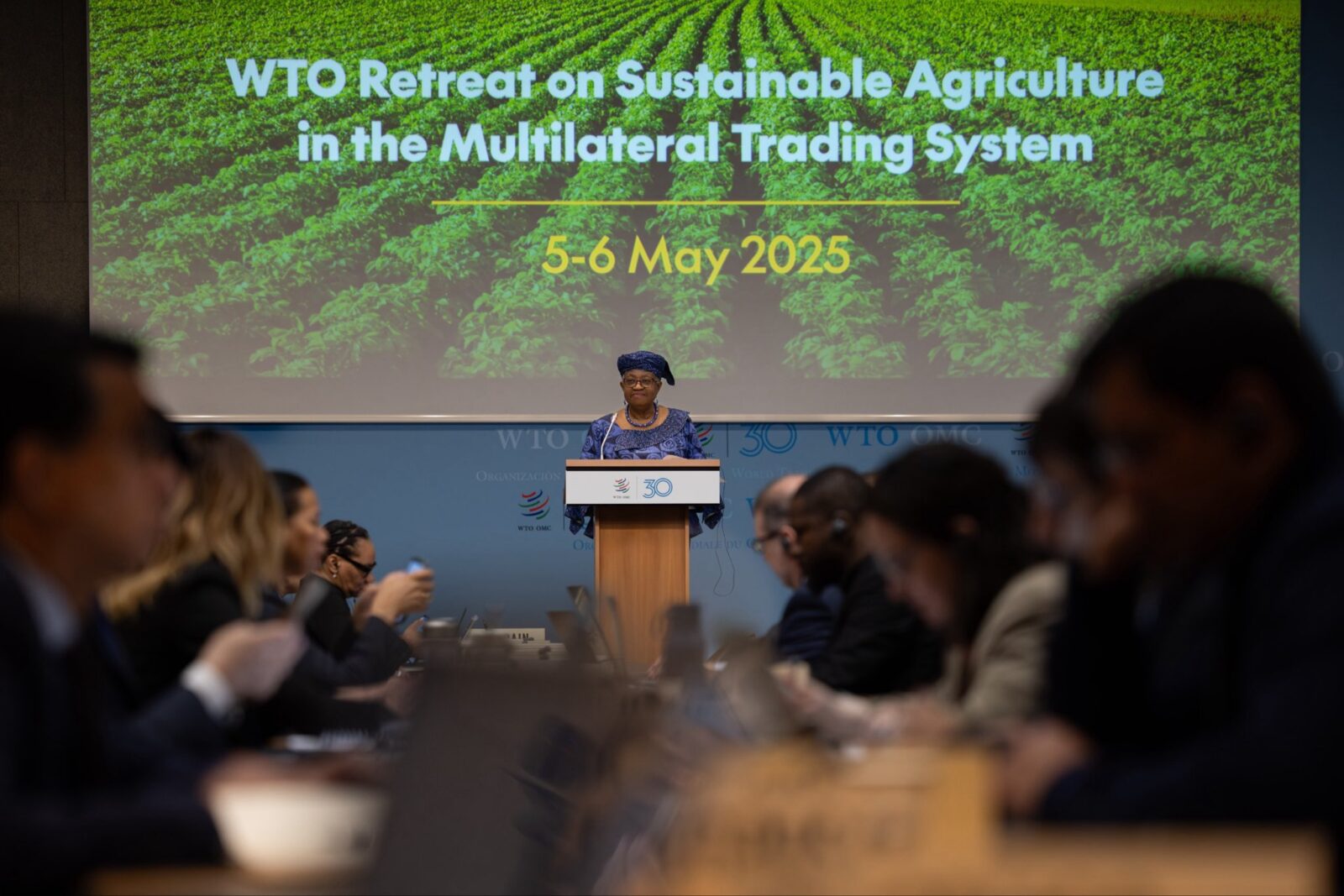
Dr. Ngozi Okonjo-Iweala’s WTO leadership faces a pivotal challenge: can she redefine global trade rules for a fragmented, evolving world?
By Brian Reuben
When Dr. Ngozi Okonjo-Iweala took the helm of the World Trade Organization (WTO) in 2021, she did so with unmatched global goodwill. The first African and the first woman to lead the WTO, she brought moral credibility, a reputation for reform, and a sense of urgency to a body in desperate need of all three. But now, several years later, one question echoes louder than ever: Can the WTO be saved?
The honest answer is both simpler and more radical: We need to redefine what “saving” even means.
The Crisis Isn’t New – It’s Revealing
The WTO’s relevance began to decay long before the COVID-19 pandemic, the U.S.-China trade war, or Trump’s belligerent disengagement from multilateralism. But what we are witnessing today is not the breakdown of the WTO’s structure; it is the exposure of its foundational limitations.
It was built in the 1990s for a global economic consensus that no longer exists. Globalization is now about semiconductors and digital sovereignty, not soybeans and textiles. Economic security and national resilience now weigh more heavily than comparative advantage.
The WTO is trying to referee a game whose rules are being rewritten mid-play.
Reform: The Comfort Blanket
Whenever institutions face existential questions, they reach for the lowest-hanging rhetorical fruit: reform. But let’s be honest—“WTO reform” has become a euphemism for inertia.
Talk of reform often focuses on process tweaks: improving transparency, streamlining negotiations, restoring the Appellate Body. Worthy goals, but these are peripheral issues. Reform in this sense is more about survival than relevance.
In truth, the WTO doesn’t just need to function better. It needs to matter more.
Restructuring: The Hard Option
If relevance is the goal, then restructuring is the path. But restructuring is not just hard; it is geopolitically treacherous.
A genuine restructuring would mean:
Abolishing the consensus rule, which grants effective veto power to the most obstructionist states.
Creating variable geometry so that developing countries are not forced to compete under rules designed for industrialized economies.
Integrating new issues like carbon tariffs, data governance, and AI (Artificial Intelligence) supply chains into the core mandate.
This path requires admitting that the existing system is structurally incapable of adapting to 21st-century trade dynamics. And it demands confronting the uncomfortable reality that major players—the U.S., China, EU (European Union), and India—are no longer invested in a shared trade architecture.
Renewal: The Radical Possibility
Here lies the real question: should the WTO be saved at all? Or should it be allowed to give way to a new institutional architecture that reflects today’s realities?
Regional trade pacts are proliferating: RCEP (Regional Comprehensive Economic Partnership), CPTPP (Comprehensive and Progressive Agreement for Trans-Pacific Partnership), and AfCFTA (African Continental Free Trade Area ). Bilateral deals based on national interest rather than global consensus are now the norm. Even issue-based mini-lateralism—coalitions of the willingly focused on specific domains like digital trade or green technology—are gaining traction.
Renewal might not mean fixing the WTO. It might mean using it as a dignified transition vehicle toward a post-WTO era. A platform for coordination, bridge-building, and historical closure.
Okonjo-Iweala: Caught Between Diplomacy and Disruption
Dr. Okonjo-Iweala is a rare figure in global governance. She has credibility across hemispheres and ideologies. But she faces an impossible brief: deliver 21st-century outcomes from a 20th-century mandate.
Her leadership has brought visibility, legitimacy, and energy to a stagnant institution. But even she cannot conjure shared political will out of thin air.
To be effective, she must now confront the painful truth: the WTO’s crisis is not just a leadership challenge. It’s an identity crisis.
So, What Does Saving the WTO Really Mean?
If “saving” means keeping the secretariat open, holding ministerial meetings, and issuing communiques, then yes, the WTO can be saved.
If it means restoring its position as the central pillar of global trade governance—binding, authoritative, and comprehensive—that may no longer be possible.
But if saving the WTO means repurposing it for a new role: as a forum for mediation, as an archive of norms, as a transitional mechanism toward next-gen institutions—then Dr. Okonjo-Iweala might be precisely the leader needed for this new phase.
Because in the end, saving the WTO may not be about bringing back the past. It may be about preparing the world to move forward with wisdom, fairness, and institutional grace.
Confiance News
Dr. Brian O. Reuben is the Executive Chairman of the Sixteenth Council.





Leave a comment