



Joan Chioma Obinagwam
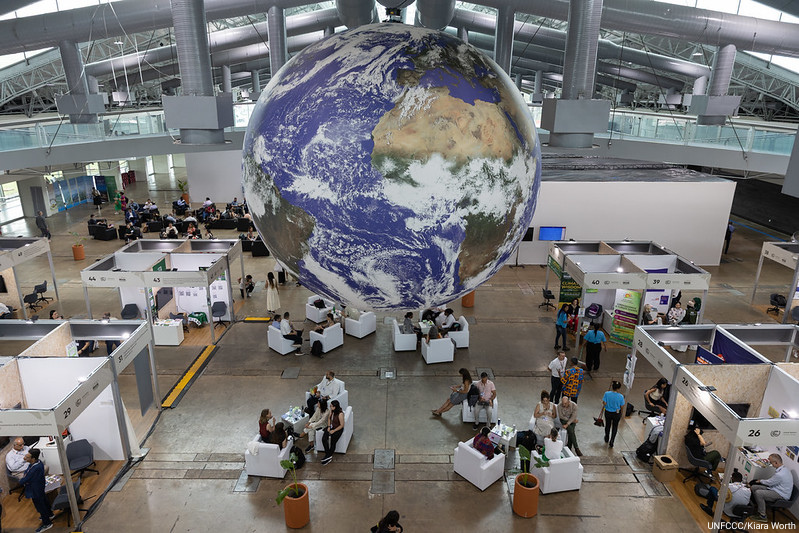
The United Nations (UN’s) COP30 summit in Belém, Brazil convened world leaders who did not just gather to delibrate about slashing emissions, they also agreed to declare war on the invisible enemy strangling climate action—lies necessitated by disinformation and misinformation.
Confiance News gathered that 12 nations – from Brazil and Canada to France, Germany, and small island beacon Vanuatu – inked a historic “Declaration on Information Integrity on Climate Change.” It is a seismic pact to crown science-based facts as the unassailable bedrock of global #ClimateAction, vowing to dismantle the web of disinformation and misinformation that is poisoning public trust and stalling progress
This is not abstract diplomacy. It is a frontline assault on the “denialism” that has let fossil fuel giants rake in trillions while wildfires rage and seas swallow shores. Brazilian President Luiz Inácio Lula da Silva, kicking off the summit with fire in his eyes, branded COP30 the “COP of Truth.” “In the era of fake news and misinformation, the obscurantists reject not only the evidence of science but also the advances of multilateralism,” he thundered. “They manipulate algorithms, sow hatred and spread fear. It is time to deliver yet another defeat to denialism.” French President Emmanuel Macron echoed the alarm: climate disinformation is not just bad info – it is a dagger to democracies, the Paris Agreement, and our collective security.
But as delegates high-fived over this breakthrough, the digital trenches erupted. Netizens and social media voices lit up X (formerly Twitter) with a frenzy of cheers, jeers, and raw fury – a microcosm of the polarized battlefield this declaration aims to tame.
Social media erupts
The announcement hit like a thunderclap, igniting over 23,000 views on the UN’s official post alone. Supporters flooded timelines with hope. Climate activist Dr. Melissa Lem, speaking at COP30, warned that “climate lies are not harmless – they are deadly,” noting how disinformation lets polluters thrive while frontline communities drown in floods and bake in heatwaves. EcoPlum, an environmental marketing firm, hailed it as a win for “#FactsMatter,” urging a flood of evidence-based info to drown out the noise. And whistleblower scientist Rebekah Jones celebrated the pledge as a long-overdue nod to the “crisis of information integrity,” where facts finally get a seat at the COP table.
Yet, the backlash was ferocious, laced with cries of censorship. Climate skeptic Steve Milloy mocked Lula’s rhetoric as “communist ravings,” rolling his eyes at the “denialists” label. Broadcaster Andrew Neil slammed the entire COP circus as a “failure,” pointing to record emissions and a rainforest-ravaging road to the venue as proof of hypocrisy. Fossil fuel advocate Jusper Machogu fired back harder: “We should never entertain such irrational ideas based on the human global warming scam,” arguing a warmer world spells prosperity, not peril. Historian Neil Oliver branded the whole Agenda 2030 push a “hoax and scam,” spotlighting private jets and diesel cruise ships as elite greenwashing. Conservative voices like Ben Leo decried media silence on debunked “disaster” stories, questioning if we are truly “trusting the science.”
These reactions underscore the chasm: for one side, it is a lifeline; for the other, a muzzle on debate. Engagement soared – Neil’s post alone racked up nearly 2,200 likes – proving disinformation does not just spread; it polarizes at warp speed.
Experts weigh in
The declaration is not flying blind – it is backed by a chorus of heavy-hitters who see disinformation as climate’s silent killer. UN Secretary-General António Guterres called it a “critical juncture,” insisting we must “fight mis- and disinformation, online harassment, and greenwashing” to let scientists “tell the truth without fear.” UNESCO Director-General Audrey Azoulay amplified the urgency: “Without access to reliable information about climate disruption, we can never hope to overcome it,” pledging support for journalists risking their lives to expose truths amid social media’s “rampant” lies.
Frederico Assis, COP30’s special envoy for information integrity, warned that disinformation “compromises every part of the COP process” – from negotiations to public mobilization – turning it into a “strategic barrier” to action. Germany’s Jennifer Morgan, State Secretary for International Climate Action, framed it as a “crisis of communication”: “We cannot mobilise the global public if the truth is drowned by misinformation. Information integrity must be treated as a global public good.” Reporters Without Borders (RSF) praised the move as a “major step forward” for protecting environmental journalists, urging regulation of online platforms and media sustainability policies.
Skeptics, however, cry foul. The Committee for a Constructive Tomorrow (CFACT) labeled it an “Orwellian” assault on free speech, accusing the UN of quashing “scientific inquiry” to prop up a faltering narrative amid funding shortfalls. The New American echoed this, calling it “narrative control” to dodge scrutiny of failed predictions and green energy flops. Even as experts like Charlotte Scaddan, UN senior advisor on information integrity, point fingers at foreign states and Big Tech for amplifying falsehoods, critics argue it is a ploy to silence legitimate debate.
How lies cripple climate action
Disinformation is not a sideshow – it is sabotage. It erodes public trust, polarizes societies, and delays policies, with a 267 percent spike in COP-related falsehoods from July to September alone. For countries like Vanuatu – where rising seas threaten erasure – it means stalled adaptation funds and ignored pleas for justice. Nigeria, a signatory, faces amplified denial that hampers its shift from oil dependency, while Brazil battles Amazon arsonists fueled by “fake news” myths.
Globally, it weakens the Paris Agreement’s spine: exposed citizens balk at carbon taxes or renewables, letting emissions hit records despite COP vows. It endangers lives – from harassed scientists self-censoring to communities dismissing heatwave warnings as “hoaxes.” And it polarizes politics: in the United States, it bolsters denialist lobbies; in Europe, it stalls EU green deals; in the Global South, it sows doubt on “climate justice” reparations. The result? A fractured world, where truth’s absence costs trillions and countless futures.
Expert tactics to counter disinformation
The declaration is not toothless – it is a call to arms, backed by a Global Fund that has already greenlit 447 projects from 100 countries. Experts from Climate Action Against Disinformation (CAAD) and the Union of Concerned Scientists, among others, have outlined a series of battle-tested tactics to combat the spread of falsehoods.
Governments must adopt universal definitions of climate disinformation – for example, clearly identifying the denial of Intergovernmental Panel on Climate Change (IPCC) consensus as a core violation – and hold digital platforms accountable through enforceable penalties for amplifying such content. This approach, endorsed by CAAD and the London School of Economics (LSE) Grantham Institute, recognizes disinformation as a major systemic threat and demands regulatory consequences.
Confiance News also reports that Media resilience must be strengthened by funding diverse, fact-based journalism and providing legal protections for reporters facing harassment. Reporters Without Borders (RSF) and UNESCO emphasize the need to sustain a robust media ecosystem capable of delivering accurate, timely coverage even under pressure.
A decisive tech crackdown is essential: mandating independent audits of social media algorithms, banning advertisements from fossil fuel interests, and granting researchers full data access to track and trace the flow of lies. The EU DisinfoLab and CAAD advocate for stricter limits on personalized advertising and data exploitation that fuel viral misinformation.
The most proactive defense lies in flooding the information space with facts. Global campaigns should deploy more than 30 science-backed statistics and pre-bunk common myths before they take root, as recommended by the United Nations Development Programme (UNDP), which stresses the power of evidence-based narratives to rebuild public understanding.
Communities themselves must be equipped with shields: citizens should be trained to recognize red flags such as sensationalism and hidden biases, while being encouraged to rely on diverse sources and verified fact-checkers. The European Commission advises a simple rule – do not engage with falsehoods, but report them and amplify truth.
A holistic research is required to uncover the economic and political roots of disinformation, enabling precisely targeted interventions. A comprehensive review published in PMC concludes that diversified, interdisciplinary methods are essential to developing operational strategies that work in the real world.
These are not temporary fixes – they are comprehensive blueprints for a sustained defense of truth. As United Nations Secretary-General António Guterres has stated, “Truth is climate action.” With COP30’s declaration, the world now possesses a clear map. The only question that remains is whether nations will have the resolve to follow it.
This pact is not perfect – non-binding, with skeptics circling – but it is a clarion call. In a post-truth era, where lies travel faster than heatwaves, upholding science is not optional. It is survival. Will the other 180+ nations sign on? The world watches.








Leave a comment