



By Joan Chioma Obinagwam
Nestlé Nigeria’s approach to integrating community prosperity with business success is a compelling illustration of the Shared Value Equation. The company demonstrates a strong commitment to sustainable community development through comprehensive policies and initiatives that address social, economic, and environmental concerns in Nigeria.
Empowering communities
Nestlé Nigeria prioritizes creating shared value by embedding community development into its business strategy. Core initiatives include sustainable agricultural support, water access projects, education, health, and women’s empowerment. For example, the Nestlé Cocoa Plan, launched in 2011, entails training over 10,000 cocoa farmers in sustainable practices and distributing 300,000 high-yielding cocoa seedlings, boosting both local livelihoods and sustainable farming. The company also invests heavily in clean water projects, constructing 15 water facilities benefiting around 50,000 people in rural communities, alongside sanitation infrastructure improvements in schools.
Reacting, Victoria Uwadoka,”Nestlé Nigeria’s Corporate Communications and Public Affairs Manager, said:”Nestlé’s success is linked to the well-being of its host communities. Our Creating Shared Value initiatives reach over 50,000 families across Nigeria annually, strengthening sustainable synergies between the company and our stakeholders.”
In health and nutrition, Nestlé supports programmes promoting hygiene, maternal and child nutrition, and disease prevention by collaborating with the Federal Ministry of Health, distributing mosquito nets to fight malaria, and educating communities on healthy living. Their women empowerment programme provides training, mentorship, and grants to rural women, helping to grow their businesses and support financial independence. Nestlé Nigeria further aids youth employment through initiatives like “Nestlé Needs, even as YOUth,” which offers technical and manufacturing skills training aligned with future workforce needs.
Greener Goals
Environmental sustainability is a cornerstone of Nestlé Nigeria’s community engagement, focusing on waste management, water conservation, and energy efficiency. The company has operated with an environmental policy since 1990 and launched employee plastic collection schemes to reduce plastic pollution, successfully managing over 6,660 kg of solid waste and 79 kg of recyclables in 2023 alone. Nestlé is also committed to transitioning to 100 percent renewable electricity by 2025 and invests in eco-friendly technologies to minimize its carbon footprint and promote responsible consumption.
Despite progress, Nestlé Nigeria faces significant challenges in addressing environmental impacts. Nigeria’s inadequate waste management infrastructure hampers recycling efforts, while evolving environmental regulations and changing consumer behavior require constant adaptability. The company collaborates with government, NGOs, and communities to overcome these hurdles, but systemic issues in infrastructure remain a barrier to efficient waste management.
Local communities have responded positively to Nestlé’s environmental efforts, particularly where the company has improved water access and sanitation near its operational sites. For instance, boreholes and repaired sanitation facilities were provided in response to concerns from residents near the Abaji plant, demonstrating Nestlé’s commitment to proactive community care beyond mere compliance.
Voices that matter
The Managing Director and Chief Executive Officer (CEO) of Nestlé Nigeria is Wassim Elhusseini, encapsulates the company’s philosophy, stating, “At Nestlé Nigeria, we believe that community development is integral to our business success. We’re committed to creating shared value for our business and the communities we serve.”
Dr. Akinwumi Adesina, President of the African Development Bank, praised the company’s community development efforts as “inspiring,” highlighting the tangible improvements in lives and livelihoods brought about by Nestlé’s initiatives.
Community leaders also recognize the company’s positive contributions. Oba Lukman Agunbiade, Alagbara of Agbara, urged women beneficiaries of Nestlé’s empowerment programmes to use the opportunities to build lasting legacies for their families, reinforcing the social impact of the initiative.
Real impact stories
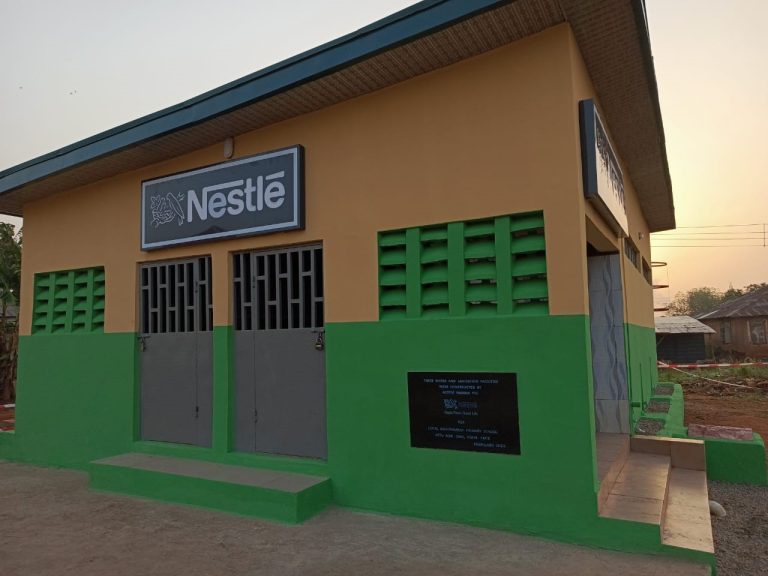
Several case studies underscore Nestlé Nigeria’s impact. The water and sanitation facility built in Adie Owe, Ogun State, serves over 500 people, including students and educators, providing vital hygiene infrastructure that directly influences public health. Reacting to Nestlé Nigeria’s Community development initiative, the Honourable Commissioner of Education, Science and Technology of Ogun State, Prof. Abayomi Arigbabu, said: “The sustained partnership with Nestlé Nigeria in promoting a conducive and sustainable environment for education is highly commendable. We appreciate the company for conceptualizing this noble idea of provision of water and sanitation facilities in schools, which is aimed at providing a healthier environment for the safety of our children.” The donation is part of a larger effort by Nestlé to build similar facilities in ten Ogun State schools, supporting the United Nations’ Sustainable Development Goal 6 (SDG-6) for water and sanitation.
The company’s investment in local maize farmers for its Golden Morn cereal supports sustainable agriculture, improving farmers’ livelihoods and securing supply chains.
Nestlé’s empowerment of rural women has enabled small retail businesses to expand up to three times their size with mentoring, training, and product grants, creating sustainable economic growth at a grassroots level. In environmental efforts, tree planting initiatives not only foster community pride but also contribute to carbon sequestration and improved air quality.
Hurdles
While Nestlé Nigeria has made commendable strides in community development, several gaps remain that hinder the full realization of its shared value goals. Chief among these is the limited scalability of its initiatives—many projects, though impactful, reach only a fraction of the population in need. Additionally, Nigeria’s weak waste management infrastructure continues to challenge Nestlé’s environmental ambitions, making recycling and sustainable consumption difficult to sustain.
Another critical gap lies in community engagement. While Nestlé has responded to local concerns, there is room for deeper inclusion of community voices in planning and evaluation. This would ensure that interventions are not only relevant but also adaptive to evolving local needs.
Turning gaps into growth
To move forward, Nestlé Nigeria must expand its partnerships with government agencies, NGOs, and grassroots organizations to amplify reach and impact. Investing in community-led monitoring systems can enhance transparency and responsiveness. Moreover, scaling education campaigns around environmental sustainability and entrepreneurship will foster long-term behavioral change.
The call to action is clear: Nestlé must evolve from being a provider to becoming a co-creator with communities. By embedding participatory development and systemic collaboration into its strategy, Nestlé can transform its initiatives from isolated successes into enduring, scalable models of shared prosperity.
Cover photo caption: Water and sanitation facilities at LG Primary School Adie Owe, Ado-Odo-Ota Local Government, Ogun State. A beneficiary of Nestlé for Healthier Kids (N4HK), a school-based nutrition and health education programme. Photo credit: Business Hub.







Leave a comment