


By Chioma Obinagwam
Christians have been challenged to resist the temptation of walking away from God when His answers do not match their requests, warning that disappointment with God is one of the most spiritually dangerous conditions a believer can face.
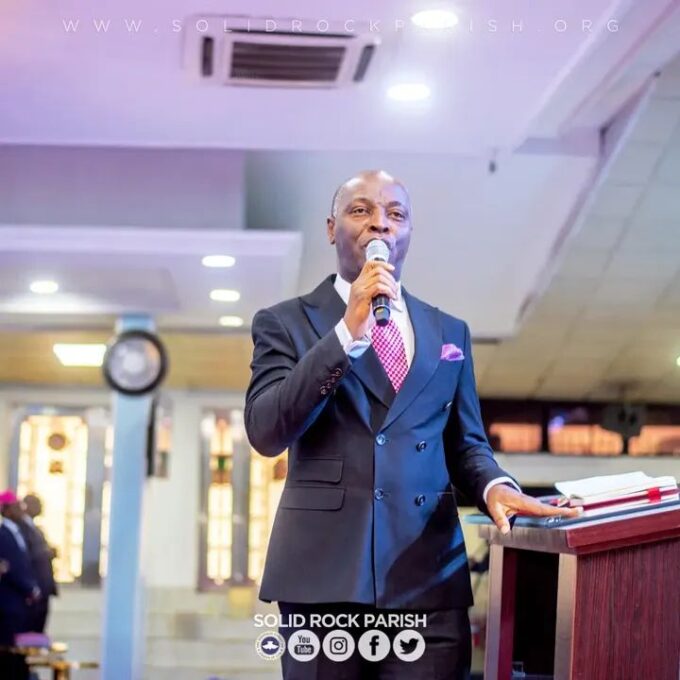
Pastor Kayode Afolayan of the Redeemed Christian Church of God (RCCG) Solidrock Parish, Lagos, delivered the charge on Sunday during a sermon.
Confiance News gathered that sermon drew extensively from the Gospels and the Epistles to explore what happens when God’s responses expose the motives behind human prayers.
“We are just lucky that God is a good God,” Pastor Afolayan told the congregation. “He is incurably loving. He is love. But oftentimes, if we are not on the same frequency with Him, we might be disappointed.”
Prayers that expose the heart
Anchoring his message in Luke 12:13-15, the pastor recalled the account of a man who approached Jesus Christ seeking intervention in a family inheritance dispute. The man expected Jesus to mediate. Instead, Jesus turned the question back on the man and warned against greed.
“He went to Jesus Christ thinking there would be succour. He thought Jesus would go and talk to his brother,” Pastor Afolayan explained. “What Jesus told him, he was disappointed because he did not get the answer he desired.”
The pastor said this pattern repeats itself in the prayer lives of many believers. When God redirects a request, He is frequently not ignoring the need but exposing the condition underneath it.
“This is usually the kind of answer we often get when we make a request to God,” he said. “It usually exposes your motive. God is more interested in your soul.”
He also referenced the account of the rich young man in Mark 10, who came to Jesus earnestly seeking eternal life and was told to sell all his possessions and give to the poor. The man left sorrowful. Pastor Afolayan noted that the answer was not a punishment. It was a revelation of the one thing the man could not release.
“When God wants to cut off something in your life and you are focused on it, you may get that kind of answer,” he said. “The best thing that man would have done was to sit down on that answer.”
The doubt of a giant
Perhaps the most striking passage Pastor Afolayan drew on was the story of John the Baptist, who, while imprisoned by Herod, sent a message to Jesus asking whether He was truly the expected Messiah or whether they should look for someone else (Matthew 11:3).
The pastor used the account to illustrate how even the most devoted believers can arrive at a place of disorienting doubt when their circumstances do not align with what they expected from God.
“John the Baptist was in prison and sent a message to Jesus Christ,” he recounted. “He was disappointed in the answer Jesus gave.”
He noted that Jesus responded not with a direct declaration but by pointing to the evidence of His ministry: the blind receiving sight, the lame walking, lepers being cleansed, the deaf hearing, the dead raised, and the poor receiving good news, the very signs foretold in the book of Isaiah.
“Whatever happens to you, do not let it get to the point where you ask God, ‘Are you the one or should I find my level?'” Pastor Afolayan warned. “Most of the things that make you say such things are mundane.”
He then offered what he described as a prayer every Christian should carry: “May I never take offence against you, Lord. May I not be disappointed in my Christian race to the point of denying Jesus.”
Contentment as a spiritual discipline
Drawing from 1 Timothy 6:6, Pastor Afolayan told the congregation that true godliness is inseparable from contentment, not as passivity or lack of ambition, but as an active trust in God’s direction during seasons of waiting.
“What godliness means is being contented with what you have until God takes you to where He wants you to be,” he said, before issuing a pointed caution: “And what God will not give you, may you never get it.”
He urged the congregation to interrogate the source of material gains, noting that what is obtained outside the will of God carries burdens that the recipient was never designed to carry.
Overcoming, not losing
Turning to Romans 8:35-37, Pastor Afolayan reminded the congregation that the Scriptures do not promise exemption from hardship but guarantee victory through it.
“There is something constant about God,” he said. “Even in all these tribulations, we are still conquerors, overcomers.”
He cited Hebrews 13:5, where God declares He will never leave nor forsake His people, and told the congregation that those who remain with God will outlast every pressing circumstance.
“God already knows what He wants to make out of your life,” Pastor Afolayan said. “He will not mismanage your life. As long as you stay with God, those things will pass away. You will remain.”
He also offered an observation on doubt, telling the congregation that the presence of doubt does not signal the absence of faith. “Any time you see yourself doubting God, it means you believe,” he said. “Lord, please help me. Do not let the situations overwhelm me.”
The cross as a plus sign
The sermon concluded with a visual reflection that drew a quiet response from the congregation. Pastor Afolayan noted that the sign of the cross, looked at plainly, is a plus sign.
“This implies that in Christ, there are many blessings,” he said. “People do not go to hell because they are sinners but because they simply rejected the love of Christ.”
He closed by urging every member of the congregation not to allow temporary disappointments to sever the relationship between them and a God whose love, he said, remains constant regardless of what prayers go unanswered.
“God can do all things,” he told them. “There is nothing beyond God.”








Leave a comment