



Abubakar Abdulrasheed
The last time Anowo Victor could see the world around him clearly was when he was 14. Before glaucoma took his sight in 2002, he could recognise people from a distance, identify familiar faces and navigate his surroundings without assistance. Now, the 38-year-old Ogun State-based graduate has learnt to live independently using assistive technologies.
He reads books in Braille, a tactile reading and writing system used by blind and visually impaired people. He also walks with a white cane and operates his phone and computer using screen-reader software that converts on-screen text into speech. These tools have helped him regain much of the independence he lost with his sight.
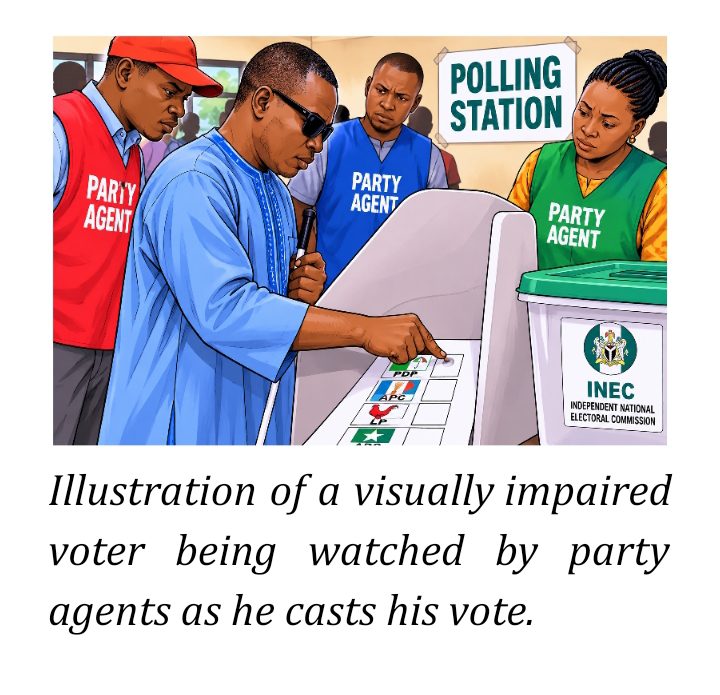
Voting, however, remains a different experience. Despite efforts by Nigeria’s electoral commission to make elections more accessible for people with disabilities including visually impaired voters, Mr Victor said he has repeatedly struggled to cast his ballot without revealing his preferred candidates to third parties.
His first experience voting at polling unit 16, Papalanto Ward 6 in Ewekoro Local Government Area of Ogun State, during the 2007 presidential general election left him questioning whether participating in elections was worth the struggle. He recalled enduring a long queue in a crowded polling environment.
“The stress to even get myself to the front was much. It was a battle because I had to go in a queue, and when other people pushed, I got pushed too,” he said.
When his turn eventually came, he said, he was asked to disclose the candidate he intended to vote for before an assistant could be selected among the parties’ agents. He was later assisted by the party’s agent of his candidate alongside his brother, who had accompanied him to the polling unit.
“I didn’t see the sense of undergoing that stress and then having to tell another person who I wanted to vote for. That defeats the purpose of a secret ballot system we are using in Nigeria,” he said.

INEC officials counting votes during the 2026 Osun State governorship election. (Credit: Abubakar Abdulrasheed)
Mr Victor’s experience reflects a longstanding challenge for blind and visually impaired voters who cannot independently identify parties on ballot papers. Their participation in elections often requires them to disclose their political choices to third parties, potentially undermining Nigeria’s secret ballot system.
While Nigeria’s electoral laws allow voters with visual impairments and certain other disabilities to receive assistance from accompanying person, post election reports documented that such measures often compromise voter autonomy, confidentiality, and democratic integrity.
The challenge of accessible voting has long been a focus of disability-rights advocacy groups in Nigeria. The #AccessNigeria campaign, an advocacy initiative led by the Inclusive Friends Association (IFA), which advocates participation of People with Disabilities (PWDs) in electoral processes including demand for accessible elections.
The advocacy campaign, however, recorded a major milestone in 2018 when the Independent National Electoral Commission (INEC) adopted the Braille ballot guide designed by IFA in collaboration with the Network for the Advancement of People with Visible Disabilities (NAPVID), for the September 2018 Osun State governorship election.
The deployment of the guide marked the first time the material was deployed in Nigeria’s election history despite its earlier suggestion in the 2010 Electoral Act, as amended, under Section 56 (2).
A Braille ballot guide is a thick envelope-like template that allows blind voters to read and identify the political parties listed on the ballot, and guides a voter’s finger to the thumbprint box corresponding to the voter’s party choice. It was deployed to ensure that visually impaired and blind voters cast their ballots independently and secretly. IFA demonstrated the use of the guide.
While the pilot of the guide offered a practical alternative to assisted voting, the commission subsequently deployed it in the 2019 general elections, making its first national-wide deployment in Nigeria’s electoral history, along with magnifying glasses, which was first adopted during the 2017 Anambra State off-cycle governorship election.
 Braille ballot guide displayed by INEC ad-hoc staff during the 2020 Ondo State governorship election. (Credit: IFA)
However, accounts from blind and visually impaired voters and findings by election observers established that deployment of the Braille ballot guide has not consistently translated into its availability at polling units of voters that needed it.
A promise that often missing at polling units
For Mr Victor, the introduction of the Braille ballot guide offered the possibility of a voting experience different from the one he had endured since 2007. He hoped he could finally exercise his franchise independently and without disclosing his political preference to another person.
But that hope was dashed during the 2019 general election when he discovered that the guide was unavailable at his polling unit. He said its absence prevented him from voting in both the presidential and governorship elections that year.
“I couldn’t vote in 2019 when they started the Braille fully. I asked like three people from my polling unit to confirm if the material is available and they got back to me that the ad-hoc staff was even asking them what they meant by that. So, it is just the same way we used to vote,” he said.
“I’ve never come across any Braille guide since I started voting in 2007,” he said.
His experience did not improve in 2023 too despite INEC re-assured deployment of the material to ensure every disabled voter counts. He stated that he waited for about an hour at his polling unit before discovering that the tool was again unavailable, and had to vote with the assistance of his relative along with a party agent.
Mr Victor also said the election officer did not give him priority despite his visual impairment. He remained in the queue as other voters proceeded to the front to receive their ballot papers until a Civil Defence officer intervened.
“I voiced out to the officials that I’m not supposed to be on the queue,” he said, explaining that he had expected to receive priority treatment and access to the ballot guide. Instead, he said, officials told him that “no Braille guide was available.”
He expressed that the experience was particularly disappointing because he had attended an INEC pre-election training in November 2022 on how to use assistive materials, including the Braille ballot guide, alongside other visually impaired voters, ahead of the 2023 general election. He added that they were also encouraged to share the information with other voters.
“When we got to our polling units on the election day, nothing like Braille was available,” he said, adding that other visually impaired voters reported similar experiences on their WhatsApp group chat.
He said the experience left him hoping that INEC would move beyond promises and ensure that the materials reached the people who needed them.
“INEC should make their yes to be yes. If they tell us they want to provide Braille, they should make sure we are able to access it,” he said.
Mr Victor’s account reflects concerns raised by disability-rights advocates and election observers about the unavailability of assistive voting materials during the 2023 general election.
In a preliminary assessment of the February 2023 presidential election, TAF Africa’s Persons with Disabilities Election Hub reported that Braille ballot guides were available in only 26 of the 273 polling units covered by its observers. The organisation said INEC was expected to provide 8,117 Braille guides across 5,957 polling units nationwide for visually impaired voters.
However, its post election report recorded that 75% of the polling units with blind voters had no Braille ballot guide for the visually impaired. The figure pointed to a substantial gap between the expected deployment and what observers found at the expected deployment locations:
The problem predates the 2023 election. Yiaga Africa’s observation of the 2019 general election found the ballot guides in 46 per cent of the expected polling units it monitored. During the 2020 Ondo governorship election, its observers reported guides in 59 per cent of monitored polling units, while magnifying glasses were present in 27 per cent.
The gap between the materials announced by INEC and their availability at polling units has consequences beyond inconvenience. Without the guides, visually impaired voters who want to participate must either rely on third parties to help mark their ballots or risk not voting at all.
For Oyewale Oyetunji, who was born with a congenital visual impairment and became blind in 2005, the absence of the Braille ballot guide turned his years of anticipation into disappointment.
Mr Oyetunji, who registered as a voter in 2011, said the 2023 general election was the first time he voted. He had previously been deterred by the difficulties he expected to encounter at polling units.
He said the announcement that the ballot guides would be available encouraged him to participate, but the materials were missing when he arrived at his polling unit, unit 20, Ward 5 in Akinyele Local Government Area in Oyo State.
“I was aware they were going to provide a ballot guide, but it was just an empty promise. I went out for the first time to vote during the presidential election, but what drove me to go then was the ballot guide they said but that was unavailable,” he said.
He also said officials and a party agent asked him whom he wanted to vote for, despite his preference for voting independently.
“I had to tell them because clearly they wouldn’t allow me to proceed if I didn’t reveal it to them,” he said.
Mr Oyetunji said the INEC officials did not introduce any assistive voting system to him. Instead, he had to rely on the assistance of a party agent and his younger brother to mark his ballot.
For him, the absence of the guide meant that his first election experience was still shaped by the same dependence that the tool was supposed to eliminate.
He said he hoped INEC would ensure the materials are available at every polling unit where they were required and train officials to understand how to use them.
Training without the promised tools
Oladipupo Confidence, 25, a mass communication student at Obafemi Awolowo University, Ile-Ife in Osun State was also among the visually impaired voters trained by INEC ahead of the 2023 general election.
She said the training in Ekiti State gave participants reasons to believe they would be able to vote independently with a Braille ballot guide. She added that they were shown how to use the tool and were told that the materials would be distributed to their polling units.
Confidence took the advocacy beyond the training, she went ahead to enlighten other visually impaired voters in her communities on the deployment of the guide. But on the election day, she was disappointed as the promised ballot guide was not available when she approached her voting location, polling unit 8, Ward 6 in Ikere Local Government Area (LGA) of Ekiti State, along with other visually impaired voters in her community.
“They said that people who assist blind people during voting sometimes compromise by picking another party different from the choice of those blind voters,” Confidence said, recounting what participants were told during the training.
“That’s why they want to teach us how to vote on our own. So, in order to avoid such a thing, they said they made something available, and that’s a Braille ballot. We actually saw it and trained on how to use it. But it was not available on election day in 2023,” she said.
She said the experience left participants relying on people they trusted to help them mark their ballots.
“It was the same old way that we voted; nothing changed. You have to bring someone you trust to help you vote,” she said.
Confidence also raised concerns about whether the participation of visually impaired voters was properly recorded. She said participants had been told that officials would present a EC40H form to record their disability status, but she did not see the form at her polling unit.
She recalled that, during the announcement of votes counted in her Ward, officials said no person with a disability had voted. She disputed the claim, saying visually impaired voters had participated.
“Even when the vote was counted, they did not recognise that there was any disabled person who voted,” she said.
Her account raises a separate question about the quality of data INEC collects on the participation of voters with disabilities, which it would later admit is a major setback for deployment of assistive tools. Experts also said reliable data are important for identifying polling units that need assistive devices and measuring whether inclusion measures are working.
The scale of INEC’s spending on elections has continued to rise over the years. Between 1999 and 2023, the commission had spent over N900 billion across seven election cycles. In 2019, it spent approximately N242 billion on the general election, while expenditure rose to about N355.3 billion in 2023, a 47 per cent increase on the 2019 election spending.
It has had proposed a budget of N873 billion for the 2027 election exercise, a 145 per cent increase from its 2023 elections expenditure

INEC’s election expenditure across the seven election circles since 1999. (Credit: Dataphyte)
What the law requires
Nigeria’s legal framework recognises the right of persons with disabilities to participate in elections and places responsibilities on the electoral commission and government to facilitate that participation.
Section 54(2) of the Electoral Act 2022, which was in force during the 2023 general election, required INEC to take reasonable steps to assist persons with disabilities, people with special needs and vulnerable voters at “polling place by the provision of suitable means of communication, such as Braille, large embossed print, electronic devices, sign language interpretation, or offsite voting in appropriate cases.”
The Electoral Act 2026 retains these provisions. Section 54(2) requires INEC to take reasonable steps to assist voters with disabilities through accessible means, including Braille and electronic devices. This provision is particularly relevant to the 2027 general election, as the commission prepares for another nationwide electoral exercise.
The Discrimination Against Persons with Disabilities (Prohibition) Act 2018 also provides a legal framework for protecting the rights of persons with disabilities, including their participation in public and political life.
INEC’s Framework on Access and Participation of Persons with Disabilities in the Electoral Process, adopted in September 2018, identifies assistive devices as part of the measures needed to make elections more inclusive.
According to the lINEC data released ahead of the 2027 general elections, there are 232,658 registered voters with disabilities in Nigeria of which 19,936 recorded as having a visual impairment, representing 8.57% of the total registered PWD population on the INEC register.
The commission, however, said it is committed to improving the participation of persons with disabilities including the provision of Braille ballot guides, magnifying glasses, the EC30 PWD form and sign-language interpretation in the upcoming 2027 elections.
Back in Osun, polling officers had not seen the guide
To establish whether the Braille ballot guide was deployed or available to voters during the August 15 Osun State governorship election, this reporter interviewed five ad hoc INEC officers who served as presiding officers (POs) at different polling units in the state.
Each official was shown a photograph of the Braille ballot guide to help them identify the material. However, none of the five said they had seen it before or received it during the election. They also said the material was not mentioned during their training.
Hamazat Rukayat, who served in Ikire LGA, said they were not supplied with any ballot guides. She added that a training focused on assisting voters with disabilities and elderly people by allowing them to move to the front of the queue.
“They did not give us anything like that. I don’t know if there is any blind person at the polling unit where I served, but if this material actually exists, they would have mentioned it during the training,” she said.
She said their trainers also instructed them to create separate queues for elderly voters and persons with disabilities and attend to them first. She added that they were told to ensure that such voters came with someone from their families to assist them.
Abdullahi Nurudeen, who served as a PO in Ede North, also said he had neither seen nor received the guide. According to him, the training focused on other election materials and procedures, with the trainer relying on a brochure to explain the process.
“Nothing like this was given. The only thing they gave us was ballot paper. The woman that even did the training for us was rushing through it inside a brochure,” he said.
A request to INEC inquiring for clarification on how the Braille ballot guides were deployed for the elections were sent in October. However, as of the time of filing this report, the commission had neither acknowledged nor responded to the request.
INEC admits gaps in deployment
Responding to this reporter’s findings, Mohammed Haruna, INEC National Commissioner and Chairman of its Information and Voter Education Committee (IVEC), acknowledged that the commission had not consistently deployed Braille ballot guides and other assistive materials to polling units where they were needed.
Mr Haruna attributed the challenge largely to inaccurate data on the locations of voters with disabilities, saying the commission could not distribute the materials to every polling unit without adequate data on where they are required.
“We try to deploy the material, but the problem is the data. We can’t deploy these things (assistive tools) at every polling unit,” he said.
He jotted that INEC’s department responsible for inclusivity are working with disability rights organisations to identify areas with concentrations of persons with disabilities, including visually impaired voters, to improve the distribution of assistive materials for the 2027 general election.
“We work with those NGOs, some of their organisations, to tell us where there are concentrations of the disabled, so that we can deploy everything accordingly. But I think that is really a problem, we don’t seem to get accurate data regarding where exactly the disabled are,” he said.
The commissioner said the commission is continuing its efforts to obtain more reliable data and had made budgetary provisions for procuring assistive devices, including Braille ballot guides and magnifying glasses.
“Well, we can’t do anything more than to still get as much as possible accurate data, and we are doing that,” he said, adding that “there is provision already in our budget to buy all these assistive devices, whatever they have.”
Mr Haruna also acknowledged gaps in the training of election officials on the use of assistive voting materials. Responding to findings that some presiding officers interviewed had neither seen the Braille ballot guides nor received training on their use, he said INEC’s training department had identified the shortcomings and is working to address them through updated training manuals.
“All we can do is to plug the training gaps we saw, and our training manual has all these materials for how the presiding officer uses devices,” he said.
Cost, deployment and training gaps – expert reacts
Prince Gutap, an election expert and democracy consultant for Yiaga Africa, said advocacy by disability-rights groups had helped push for greater inclusion of persons with disabilities in Nigeria’s electoral process. However, he said gaps remained in voter education and the implementation of measures designed to make voting accessible.
Mr Gutap said the cost of producing and distributing assistive materials across all polling units was a consideration in their deployment. According to him, INEC generally deploys Braille ballot guides to polling units where registered voters with visual impairments have been identified.
“It is only the polling unit where they have a registered voter who has a visual disability. That’s where they will deploy such materials,” he said.
He said the Braille guides were available at some polling units observed by his organisation, especially in 2023 general elections, while acknowledging that visually impaired voters might still need assistance to reach polling locations and cast votes.
However, he identified inadequate training and voter education as challenges affecting the use of the guides. He said election officials needed proper training to understand how to administer the materials and inform voters about their availability and use.
“With adequate training of ad hoc staff, everybody knows what they are expected to do at what time,” he said.
Like Nigeria, like other African countries
Few African countries have introduced tactile ballot guides to help voters with visual impairments cast their ballots independently and in secret.
Ghana was among the early adopters, developing and piloting the guide in 2002 through a collaboration between its Electoral Commission and the Ghana Association of the Blind. The guide uses cut-out holes and raised dots to help blind voters identify where to mark their ballots.
While its post-elections reports highlighted large deployment of the guides to polling centres, a 2020 assessment by Ghana’s Commission on Human Rights and Administrative Justice documented complaints about the guides being unavailable at some polling centres and some voters struggling to use them, even when provided.

Ghana electoral officials examined the tactile ballot jacket deployed in the country’s election. (Credit: The Commonwealth)
In its 2024 elections, the deployment of the guide saw improvement as Commonwealth observers reported that tactile ballot jackets (ballot guide) were available at most polling centres. Although it noted that some visually impaired voters still required assistance.
South Africa in 2011 also developed a structured system through its Universal Ballot Templates, which feature numbered windows, Braille markings and tactile indicators to help blind voters identify and mark their preferred choices.
The templates have undergone modifications over successive elections to accommodate longer ballot papers and more political parties. However, a post-election report of 2024 noted that there was a lack of the templates at some of the polling centres, frustrating the participation of visually impaired voters.
However, Sierra Leone’s experience highlights the challenge of ensuring that such materials reach voters.
An election observation report by the European Union Election Observation Mission found that tactile ballot guides were available in only about half of the polling stations its observers visited during the country’s June 2023 elections.
- 2027 elections
- accessible voting for visually impaired Nigerians 2027
- blind voters
- blind voters in Nigeria elections
- Braille ballot guide
- Braille ballot guide polling units 2023
- Confiance News
- Electoral Act 2026 persons with disabilities
- how blind Nigerians vote independently
- INEC
- INEC assistive voting materials for disabled voters
- INEC Braille ballot guide unavailable
- Nigeria elections
- secret ballot
- visually impaired voters



Leave a comment