



By Chioma Obinagwam
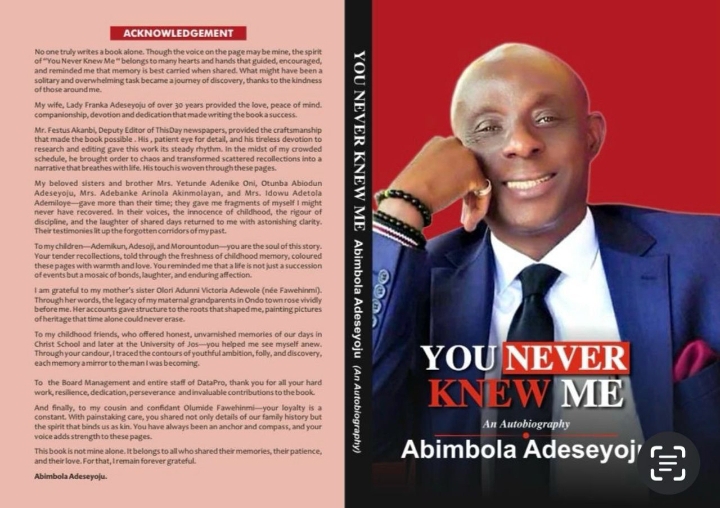
By 1982, Abimbola Adeseyoju had failed his exams twice, wasted five years, and had no idea what “Compliance” or “Rating” meant. A voice told him that was his future. Today, DataPro is Nigeria’s compliance backbone. Sometimes the people who look most lost are the ones going somewhere no one else can see.
Chapter One: With My Mother, Parenting is Forever
This opening chapter is the emotional heart of the whole book. Adeseyoju introduces the two people who shaped him most: a hard-working Christian father and a fiercely principled Muslim mother from the celebrated Fawehinmi family. His mother, Sidikat, is painted with such tenderness that you feel her presence on every page. Her secret? Unconditional love, even when her son was at his worst. A mother who chose to calm rather than condemn. A lesson every parent should read.
Chapter Two: The Growing Up Years
Schoolboys, bicycles, football bets, and the hallowed halls of Christ’s School, Ado Ekiti. This chapter is warm and nostalgic, tracing Adeseyoju’s boyhood through a series of vivid, often humorous memories. But underneath the fun lies a serious point: good foundations matter. His father’s insistence on elite education and his mother’s grocery-stocked locker at the boarding house were quiet acts of love that would later pay dividends. Then came 1977 and the infamous “Expo ’77” scandal, which swallowed an entire generation’s results whole. The chapter ends with a boy who was bright, well-prepared, and suddenly undone by something completely outside his control.
Chapter Three: The Gap Years
This is where the book finds its soul. Between 1977 and 1982, Adeseyoju was adrift: smoking, drinking, failing exams, and crashing cars that did not belong to him. He calls these his “wilderness years,” and the comparison to the biblical David is apt. What saves him is a combination of an uncle who drags him to Mubi, a mother who never gives up on him, and a voice in the night that tells him his future is bright and that he will become an entrepreneur in “Compliance and Rating.” He does not even know what those words mean. This chapter will resonate with anyone who has ever felt that life is passing them by.
Chapter Four: The Family Man
After years of wandering, Adeseyoju finds his footing and then finds love. His account of meeting Francesca “Frankie” Omigie is charming, and her voice throughout this chapter is refreshing. She describes a man who is blunt, fearless, and fiercely devoted. He resigned from his job and told her about it afterward. She was shocked. She stayed. The chapter is honest about the early struggles of a young marriage, a single car, a rented flat, and a new company all happening at once. It is a portrait of a partnership built on trust rather than comfort.
Chapter Five: Parenting: Building the Present on the Legacies of the Past
Adeseyoju the compliance expert becomes Adeseyoju the father, and he brings the same framework to both. He assesses each child’s “risk profile” before deciding how to parent them. Three very different children, three very different approaches, all shaped by the values poured into him by his mother. The children speak for themselves here, and their testimonials are the most moving part of the chapter. They describe a father who showed up early, paid school fees first before buying anything for himself, and never let them doubt that they mattered.
Chapter Six: DataPro: A Vision Foretold
Here the prophecy becomes a business plan. Adeseyoju traces the founding of DataPro in 1995 with three people, one borrowed office, and a Dun & Bradstreet franchise. The chapter is rich with detail: the sleepless commutes from Ogba to Lagos Island, the internal memo that made a chairman sing, and the friend who mentioned Dun & Bradstreet in passing and changed everything. What stands out is how God-ordained and entirely practical the story is at the same time. The voice in Mubi said “Compliance and Rating.” Thirty years later, that is exactly what DataPro does.
Chapter Seven: Shaping the Credit Rating Industry in Nigeria
This is the chapter for anyone who wants to understand what DataPro actually built. Adeseyoju breaks down credit ratings in plain language, without losing depth. He explains how DataPro became Nigeria’s third licensed rating agency in 2004, the controversy sparked by their unsolicited “Top 20 Insurance Companies” report, and how they slowly won the market’s trust through consistency, transparency, and refusal to simplify their integrity. It is both a business history and a quiet argument for why financial credibility matters.
Chapter Eight: Becoming a Data Protection Compliance Organisation (DPCO)
Nigeria’s data protection landscape, from NDPR to NDPA, is explained here with remarkable clarity. Adeseyoju walks the reader through how DataPro became one of the country’s first licensed DPCOs, and why that felt inevitable. The name “DataPro” seemed almost prophetic, he says. The chapter also covers the scandal of predatory lending apps and how the Cambridge Analytica crisis pushed Africa toward stronger privacy laws. It is a timely chapter for anyone in business who handles customer data, which is everyone.
Chapter Nine: How We Built the Largest Country PEP List in the World
This chapter reads like a quiet adventure story. Adeseyoju describes how his team spent over a decade crossing all 774 Local Government Areas to build NiPEL, Nigeria’s Politically Exposed Persons database. The challenge was enormous: no standardised identity system, uncooperative gatekeepers, and a political landscape that shifts constantly. Their solution was ingenious: add photographs to eliminate mistaken identities. Today, NiPEL is used by about 80% of Nigerian financial institutions and has crossed borders. It is a case study in problem-solving for a country the world rarely gives credit to.
Chapter Ten: DataPro: A Future Assured
The final chapter is candid and surprisingly funny. Adeseyoju describes stepping back from daily operations as DataPro turns 30, his plans for regional expansion across West Africa, his firm refusal to enter politics, and his “no airport, no visit” philosophy. He talks about Nigeria’s economy with real optimism, not the hollow kind, but the kind that comes from watching a country consistently exceed its own expectations. His parting note is disarming: this book is only Part One. If God keeps him until 80, he promises a sequel.
You Never Knew Me is a rare thing: a memoir that is equally honest about failure and faith. Adeseyoju does not present a polished success story. He gives you the smoking years, the crashed car, the WAEC results that meant nothing, and the voice in Mubi that made no sense at the time. Thirty years later, every word of that voice came true. This book is for entrepreneurs, parents, and anyone who suspects that their best chapter is still ahead of them.






Leave a comment