



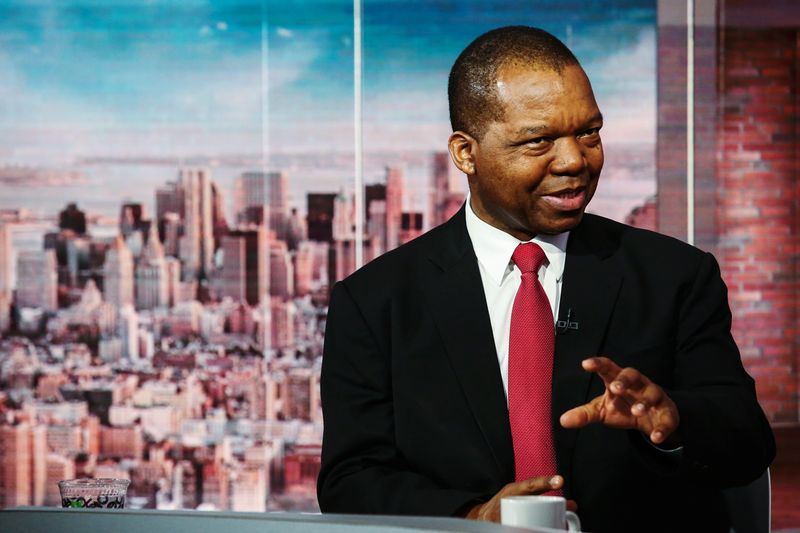
Reserve Bank of Zimbabwe Governor John Mangudya Photographer: Christopher Goodney/Bloomberg
- De facto currency weakened almost 25% since it began trading
- Gap between official-, parallel-market rates remains wide
Zimbabwe’s central bank governor said he expects the official and black-market exchange rates to converge within two months, as the currency extended its decline against the dollar to almost 25 percent.
Zimbabwe began formal trading in February of a de facto currency, known as RTGS dollars, through a newly created interbank market. While it abolished a 1:1 peg between the U.S. dollar and the RTGS$’s predecessor, so-called bond notes and their electronic equivalent, trading has been thin and the difference between the interbank rate and the black market remains wide.
Zimbabwe’s currency has a weaker value on the black market.
The currency traded at 3.2973 per dollar on Zimbabwe’s interbank market on Tuesday, compared with 2.50 when it was introduced in February. It’s weakened every trading day since March 6, according to data compiled by Bloomberg. On the parallel market on the streets of the capital, Harare, the U.S. dollar changes hands at 4.85 RTGS dollars.
“In one or two months, we will reach an equilibrium,” Reserve Bank of Zimbabwe Governor John Mangudya said in an interview at a presentation in Harare. “At the moment the parallel markets are at 4 or 5 and the bank rate is 3.3, so we are not very far from each other.”
The central bank is allowing the market to determine the RTGS dollar’s value, Mangudya said, rejecting the notion that the authorities are trying to manage the currency.
“Many people say the central bank is managing the exchange rate,” he said at the presentation to business leaders. “I don’t control the forex markets. It’s about willing buyer and willing seller.”
Mangudya also said the central bank is making progress on establishing a monetary policy committee and reintroducing debt auctions, both of which have been promised by Finance Minister Mthuli Ncube.
“Definitely before the end of this year there’ll be a monetary policy committee,” he said. “In the third quarter, we will see the auctioning of Treasury bills.”
Zimbabwe stopped offering debt through the conventional auction system in 2012, after a series of failed sales.
(Bloomberg)






Leave a comment