


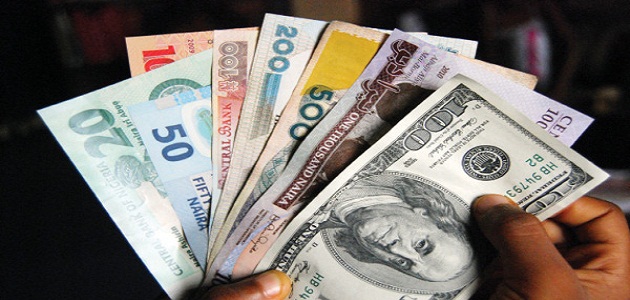
The naira on Friday depreciated past N400 to dollar at the forward market after Nigeria recorded its first case of coronavirus.
The naira was priced much weaker at N413.55 to the dollar in a year, compared with the N399.73 it traded at two weeks ago, Reuters report said.
A forward market is an over-the-counter marketplace that sets the price of a financial instrument or asset for future delivery.
Forward markets are used for trading a range of instruments, especially at the foreign exchange market.
Analysts had tipped the naira to depreciate by 10 to 20 per cent in the parallel market by 2021 as the impact of falling crude oil prices and foreign exchange reserves persist.
Local and foreign analysts predicted that a decline by 10 per cent would take the naira to about N400 to dollar, while a 20 per cent drop would see it at around N450 to dollar.
According to Bloomberg survey of investors, the local currency may be marked down by up to 20 per cent in 2021.
According to the survey, the drop in foreign reserves and lower oil prices will probably force the Central Bank of Nigeria (CBN) to devalue the naira, seen as one of the world’s most stable currencies by next year.
The continued stability of the naira against the dollar has continued to spark speculations, with many analysts predicting that the local currency will sooner or later be devalued.
The Bloomberg survey of investors and analysts, showed that 10 out of 19 respondents expect the naira to be weakened in 2021, while five predict a mark-down as early as the second half of this year.
The remainder believe the CBN will keep a firm grip on the currency until 2022 or 2023. The CBN has instituted several policies to defend the naira, including restricting importers’ access to dollars and stepping up the sale of high-yielding debt to attract inflows from portfolio investors.
The CBN has also backed the government’s closure of some land borders, designed to stop smuggling.
Most respondents say Nigeria cannot keep defending and sustaining naira’s stability beyond next year.
All but four of the survey participants said the naira is more than 10 per cent overvalued against the dollar.
Two respondents said it was at least 20 per cent too strong. The currency has traded around 360 to 365 per dollar since its last devaluation in 2017.
While the CBN says the exchange rate is determined by the market, it is much less volatile than other oil currencies, such as the Russian ruble and Kazakh tenge.
The respondents were evenly split on the size of the devaluation, with nine predicting the naira will drop 10 per cent or less and the same number saying it would be marked down by 10 per cent to 20 per cent.
Only one forecasted a fall of more than 20 per cent. Most survey participants, who included money managers, analysts and economists based in Nigeria and abroad, asked for their answers to remain anonymous.
Since June, Nigeria’s reserves have decreased by 17 per cent to $37.4 billion, the lowest in more than two years.
The slide has accelerated since the coronavirus outbreak in China rocked global markets and sent Brent crude prices down to around $55 a barrel.
Last week, reserves in Africa’s biggest oil producer fell by $350 million, the most on a weekly basis since October.
All but three of the respondents said reserves would have to hit $30 billion before the CBN considers letting the currency fall, which is in line with what Governor Godwin Emefiele told investors last year.
Emefiele had vowed to keep the naira steady, saying in late November that the slide in reserves was not a cause for concern.
“In 2016 we had reserves as low as $23 billion and we survived,” central bank spokesman, Isaac Okorafor, said after the release of the survey.
“We have proved them wrong before and we will do it again,” he told Bloomberg.
The CBN and FMDQ OTC Securities Exchange, a Lagos-based platform that oversees naira transactions, introduced new naira futures contracts of up to five years.
The aim is to attract more foreign investment by helping investors hedge their currency exposure, Tumi Sekoni, FMDQ managing director, said.
(Economic Confidential)









Leave a comment