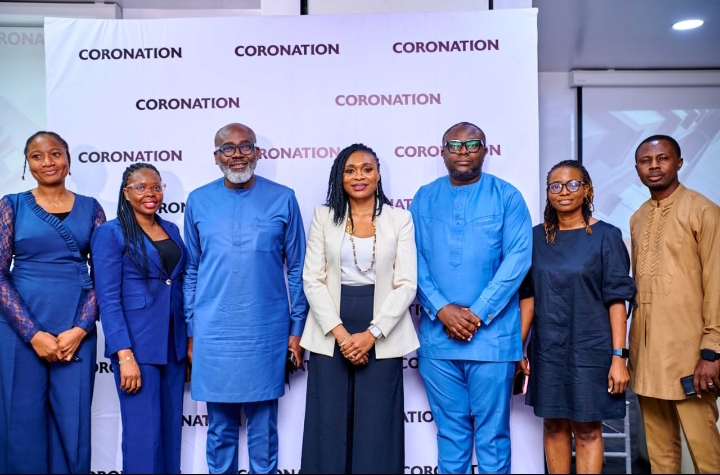
Nigeria’s capital market is approaching a defining turning point in the second half of 2026, as the historic rally that has already unfolded faces its biggest test yet: whether it can finally pull foreign investors back into the fold, according to the Managing Director of Coronation Asset Management, Aigbovbioise Aig-Imoukhuede.
Speaking at the H1 2026 Capital Market Review and Outlook for the Second Half of the year, Aig-Imoukhuede said the real question going forward is not whether the Nigerian Exchange’s (NGX) rally will continue, but whether the country can attract a fresh wave of international capital before the year runs out.
H2 2026 could be foreign investors’ re-entry window, Coronation says
Confiance News gathered that the second half of the year could represent a potential re-entry window for foreign investors, as conditions around market classification, foreign-exchange liquidity, external reserves and corporate earnings continue to improve.
That outlook follows a first half in which the NGX All-Share Index gained 57 per cent, with total market capitalisation rising by N58.9tn to close at N158.2tn as of the end of July, a performance that Bloomberg data cited by Aig-Imoukhuede placed among the strongest in the world in dollar terms. But he was quick to stress that the rally was driven overwhelmingly by domestic capital rather than a resurgence in foreign portfolio investment.
Global index providers watching Nigeria’s market classification
It was learned that international index providers are increasingly paying attention to Nigeria’s positioning heading into the second half of the year. FTSE Russell is reviewing the country’s status within its Frontier Market Index framework, while S&P Dow Jones Indices has placed Nigeria on a watchlist for possible reclassification from standalone to frontier-market status.
Although neither outcome is guaranteed, Aig-Imoukhuede said any shift in Nigeria’s classification could carry significant implications for international capital flows in the coming months, particularly passive investment strategies.
”Global capital follows confidence, but domestic capital trades on it,” he said.
Naira stability, FX liquidity to shape investor decisions through year-end
Confiance News understands that improvements in Nigeria’s foreign-exchange market will be a key factor shaping the investment case for the rest of 2026. Aig-Imoukhuede pointed to improved FX liquidity, a stronger naira and reserve accumulation backed by more sustainable inflow sources as important indicators of the country’s external resilience.
He said foreign investors will be watching closely for the sustainability of exchange-rate stability, noting that currency risk remains a major consideration when weighing Nigerian assets through the second half of the year.
Corporate earnings and ongoing economic reforms were also flagged as potential catalysts for renewed foreign investment, with the banking sector’s recapitalisation cycle and stronger corporate performance seen as strengthening Nigeria’s long-term investment proposition within the frontier-market universe.
Why foreign investors stayed on the sidelines in H1
Confiance News gathered that by June 2026, foreign investors accounted for just 12.1 per cent of total NGX transaction value, down sharply from 27 per cent a year earlier, even as domestic investors expanded their participation by 129.1 per cent over the same period.
Aig-Imoukhuede cautioned, however, against reading the drop as a full foreign withdrawal from Nigeria, noting that the value of foreign investors’ portfolios actually edged up from N1.13tn to N1.16tn in the first half. High-yielding short-dated government securities, offering returns close to 20 per cent, had instead pulled foreign attention toward fixed income.
”From a pure risk-adjusted perspective, that allocation decision was understandable,” he said.
Coronation: Investors will grow more selective in H2 2026
Looking ahead, Aig-Imoukhuede said the structural case for foreign investors to return to Nigeria is stronger now than at the start of 2026, though he stressed that investors will become increasingly selective in the months ahead.
Confiance News learned that a market which has already gained more than 55 per cent, with significant re-ratings across several large-cap stocks, is unlikely to keep rewarding indiscriminate bets in the second half. He urged institutional investors to prioritise companies with strong earnings momentum, sound corporate governance, adequate liquidity and clear upside from renewed international participation.
He also pushed back on concerns over the market’s June downturn, its first month of sequential decline for the year, attributing it largely to domestic investors taking profit after a historic first half rather than any erosion of confidence.
”Domestic investors were prudently locking in gains after a historic first half,” he said.
Three capital allocation principles guiding Coronation’s H2 2026 strategy
Aig-Imoukhuede outlined three broad principles set to guide capital allocation for the rest of the year, particularly as monetary policy remains relatively tight and investors reassess fixed-income versus equities.
With the Central Bank of Nigeria (CBN) expected to hold its Monetary Policy Rate broadly steady through year-end, he warned that the short end of the yield curve could become increasingly crowded as investors chase attractive risk-adjusted returns.
Confiance News confirmed that the CBN has held the MPR at 26.5 per cent for two straight meetings, following a 50-basis-point cut from 27 per cent in February. He described the decision to hold rates as deliberate and data-dependent rather than indecisive, citing global uncertainty, geopolitical tensions and domestic inflation volatility.
Headline inflation stood at 15.43 per cent in July, though he noted the decline has not followed a straight line, with food-price pressures still shaped by structural factors such as supply-chain constraints, logistics, agricultural cycles and exchange-rate movements that monetary policy alone cannot fix.
”At Coronation Research, our base case remains that the MPR will broadly hold at current levels through year-end. We are not forecasting a dramatic policy pivot. We are forecasting disciplined, data-dependent stability,” he said.
He added that monetary-policy stability may not generate dramatic headlines, but it creates conditions for long-term capital to be deployed with greater confidence through the rest of 2026, pointing to opportunities in quality credit, infrastructure debt and selected fixed-income instruments as investors weigh extending duration.
Confiance News gathered that Coronation remains committed to infrastructure financing for the remainder of the year, particularly in the energy and transport sectors, where Nigeria’s long-term capital needs remain substantial.
Nigeria’s capital market at its own turning point, Coronation warns
Beyond the immediate outlook, Aig-Imoukhuede said Nigeria’s capital market carries a broader responsibility heading into the second half of the year: to strengthen trust, transparency and institutional credibility. He argued that attracting more capital will not be enough unless the market also builds institutions capable of delivering the transparency, governance and investor protection needed to retain it.
He described Nigeria’s capital market as standing at its own turning point, with the first half of 2026 showcasing the strength of domestic capital, and the second half set to reveal whether foreign investors are ready to return.
”Capital could enter and exit a market quickly, while investor trust takes years to build and can be lost in moments,” Confiance News understands he said.
He expressed optimism that Nigeria is better positioned than in previous years to draw both domestic and foreign investment for the rest of 2026, provided reforms are sustained, market institutions are strengthened and macroeconomic stability holds.
”The opportunity before us is not simply to deliver market returns. It is to build a capital market that is deeper, more trusted, more liquid and more globally relevant,” he said.
He called on asset managers, market operators, regulators and other stakeholders to ensure Nigeria’s market infrastructure is ready to absorb renewed international investment in the months ahead.
”Our responsibility as firms and as an industry is to ensure that when capital chooses Nigeria, it finds institutions that are prepared, markets that are credible and opportunities that are compelling,” he said.
Aig-Imoukhuede’s remarks come as Coronation continues to position itself around long-term capital allocation and investment opportunities across Nigeria and Africa heading into the second half of 2026.



Business
 Chioma ObinagwamAugust 22, 20265 Mins read5
Nigeria’s capital market approaching foreign investor turning point in H2, says Coronation
Chioma ObinagwamAugust 22, 20265 Mins read5
Share

Related Articles

Business Chioma Obinagwam3 Mins read
NCC decries 5,000 fibre cuts, demands road contractor coordination
Nigeria’s telecommunications regulator has sounded the alarm over a wave of fibre-optic...
Chioma Obinagwam3 Mins read
Business Chioma Obinagwam1 Mins read
Safety must come first: Shell tells contractor CEOs in Lagos
EVP Elohor Aiboni says every Shell worker deserves to return home safely,...
Chioma Obinagwam1 Mins read
Business Chioma Obinagwam2 Mins read
CBN, UBA chiefs billed for FICAN’s 36th anniversary conference
Lagos confab to review banking recapitalisation, tax reform, fintech gainsNigeria’s leading financial...
Chioma Obinagwam2 Mins read



Business Chioma Obinagwam1 Mins read
Bonny Chamber to Unveil Discover Bonny Tourism Initiative
Bonny Island is set for a major tourism push as the Bonny...
Chioma Obinagwam1 Mins read

Leave a comment